Ambiguous Trading Instructions: Questions to Ask Before Acting
Decode entry zones, confirmation language, expiry and amendments without inventing the missing trading rules.
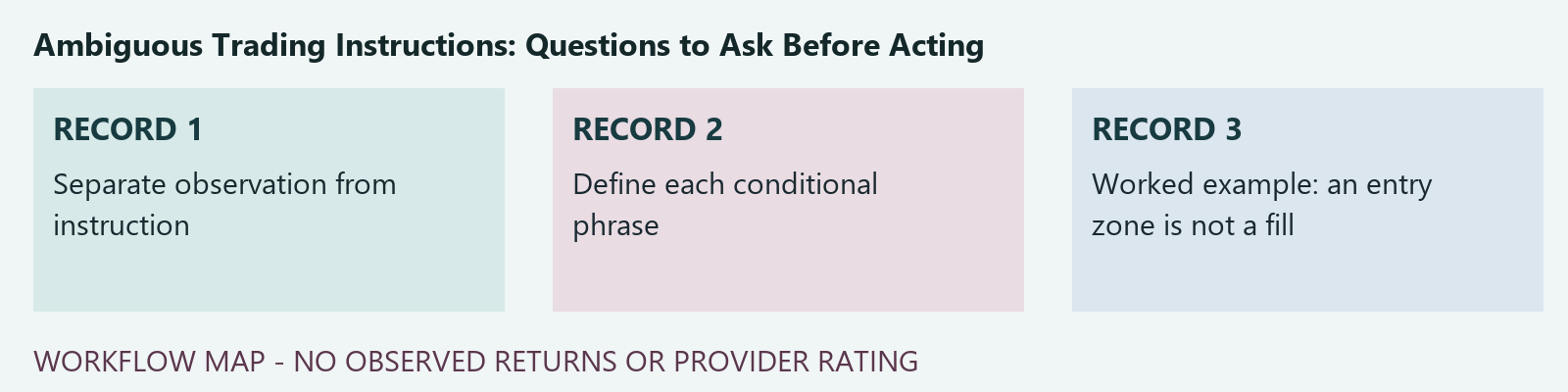
Separate observation from instruction
A message can describe a market without instructing a trade. Identify which words are commentary, which express a conditional setup and which authorise an action under the service's actual rules. A sentence saying price looks strong does not identify instrument, side, quantity or validity. Do not convert that observation into a precise entry just because the next chart move would have rewarded it. The first question is whether a complete actionable instruction was published at all.
Define each conditional phrase
Ask what confirms an entry, which price source is used and when the condition is evaluated. Phrases such as hold above, close through or wait for confirmation can refer to different clocks and observations. Record a supplied definition rather than guessing one. A closing candle value is not known at its opening time. A trader who checks every message manually may still interpret a condition differently from an automated integration; the language specification should precede either workflow.
Worked example: an entry zone is not a fill
Invent a message saying buy between 100 and 102 after confirmation. One reader buys immediately at 101, another waits for a bar close and sees 103, and a third leaves a limit order at 100 which never fills. The phrase alone does not show which action the publisher intended. Do not call all three identical executions or choose the one with the best later result. The exercise identifies missing condition, clock and order fields, not actual subscriber performance or a recommendation to use a particular entry.
Ask when the instruction stops applying
Record expiry time, session boundary, invalidation event and whether an unfilled order must be withdrawn. A later target update may refer to an already active position rather than a fresh entry opportunity. Amendments should identify the original call and explain whether existing orders are affected. Retain superseded text, since an edited message can otherwise erase the instruction a subscriber followed. A receipt time does not restart the author's validity window unless a new version explicitly grants that authority.
Translate only after the meaning is settled
Once the condition is defined, identify the intended order type and its limitations. SEC order materials supply general mechanism definitions; the broker determines which instructions and policies apply to an actual account. Keep the signal fields distinct from broker acceptance, partial fills and cancellation acknowledgements. If the provider never supplied a sizing rule, an editorial interpretation cannot fill it. Similarly, a conviction label is not automatically a calibrated probability, account allocation or contractual loss limit.
Keep an interpretation log
Write the question asked, the provider's dated answer and the exact message version to which it applies. Unanswered fields remain unknown. A later clarification may improve future calls without repairing the evidence for earlier ambiguous calls. Use the blank worksheet to compare how consistently a service defines its language rather than pretending a complete original population was tested. This guide teaches signal literacy. It does not establish profitability, prove delivery of all messages or make an incomplete instruction suitable for a particular person's account.
Decision record
| Question | Record to retain | Decision boundary |
|---|---|---|
| Action | Commentary, setup or actual instruction | Do not manufacture a trade from a market observation |
| Condition | Price source, evaluation clock and definition | Confirmation language needs an observable rule |
| Validity | Expiry, invalidation and amendment authority | Receiving an old call does not renew it |
| Translation | Order instruction and broker response | Meaning and execution are separate records |
Blank working record
The worksheet contains column headings only. Enter your own dated observations, keep absent evidence marked unknown, and do not treat the file as certification.
 Download worksheet (CSV)
Primary references
These documents support mechanisms and source definitions, not a tested trading result or a recommendation. Accessed 9 October 2026. The decision workflow and invented examples above are editorial exercises.
Keep reading
Publication methodology | Working glossary | Source and correction policy
Quote the unresolved instruction instead of guessing
Alpha's amendment note contains the words wait and market buy as quoted text, a comma and a newline. The parser preserves them literally rather than executing markup or pretending to interpret free language as an order. A true ambiguity request should retain the original message, producing version and known receiver context. This tool's declared event type is supplied by the record, not inferred from the note.
The CSV contract can be complete while natural-language intent is unresolved. A journal price might be a trigger, limit, reference or fill declaration under a different source, and a withdrawal does not necessarily authorise closure. Ask for the effective policy and actual operational records. The original ambiguity worksheet remains alongside a filled fictitious sequence; neither supplies real market history, calibrated signals, paid account observations or a universal platform semantics dictionary.