Signal validity and latency worksheet
Subtract declared transport, reading and broker delays from a hypothetical validity window.
Educational explanations, fictional scenarios and personal worksheets. No live calls, paid-account test or provider performance certification.
One publication clock
The example treats validity as starting at publication. Total delay is transport plus decision plus acknowledgement delay. Remaining time is validity minus total delay; arrival exactly at expiry is marked expired.
Not an order instruction
A positive remainder says only that these assumed delays fit inside the declared window. Price, spread, order type, partial fill and risk eligibility are not checked. Acknowledgement is not a fill.
Capture the real sequence
Keep publication, device receipt, decision, order submission, acknowledgement and execution timestamps with their clock sources. Do not infer transport delay from a provider-controlled timestamp alone.
Blank working records
Headers only. No observed trades, receipts or study findings are supplied in these templates.
Source documents
Documentation establishes the stated mechanism, not tested trading performance. Checked 9 October 2026; a later version can differ.
A remainder at acknowledgement is not execution evidence
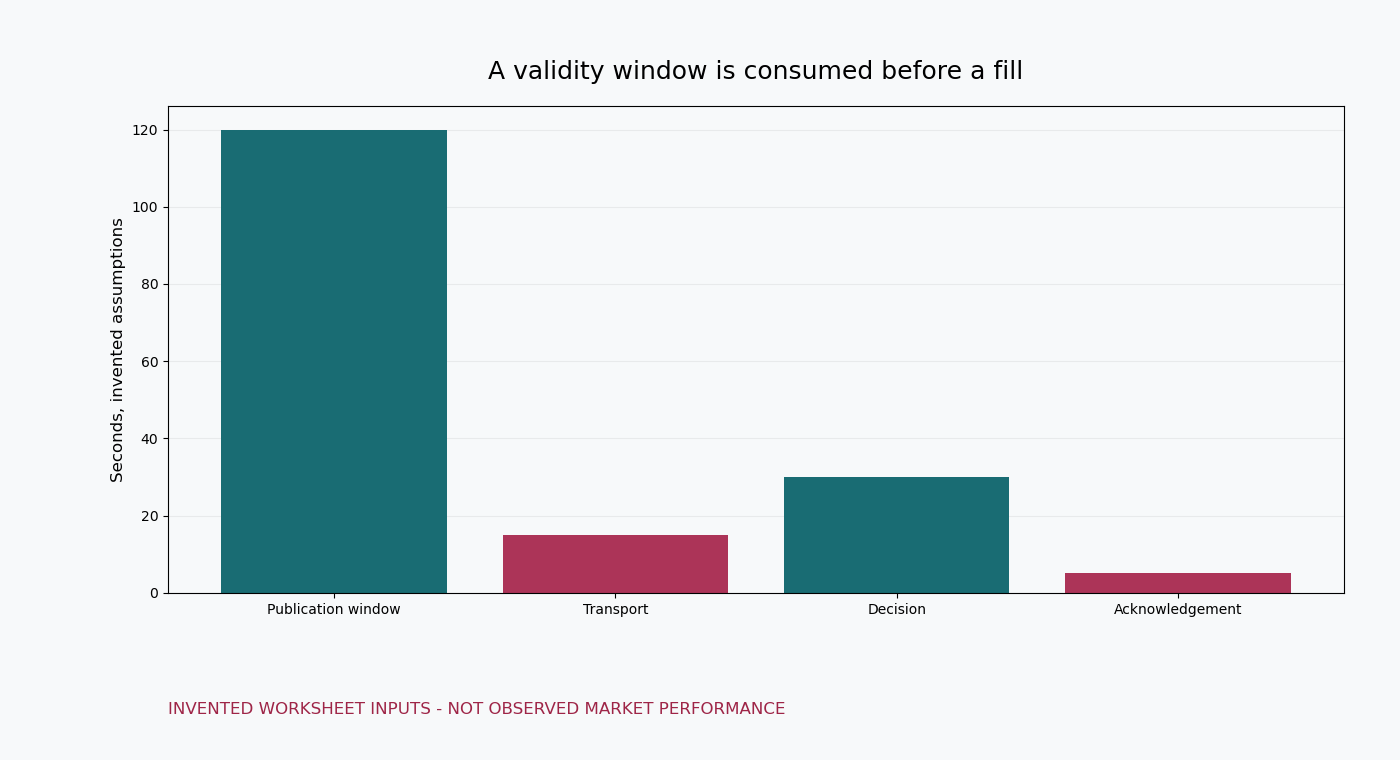
The original four-input calculation remains unchanged in meaning: transport, reader decision and acknowledgement delays consume a declared validity window. At the invented defaults of 120, 15, 30 and 5 seconds, total delay is 50 and the remaining window is 70. At exact expiry the result is expired, using greater than or equal. These are assumptions, not observed network or broker timings. A positive remainder does not establish executable price, sufficient liquidity, correct version, permissions, quantity or a fill. The new event journal therefore remains a separate record task rather than a source that validates these four input averages.
Filled interpretation finding
Alpha's acknowledgement receipt appears before its earlier amendment receipt, so a single total-delay assumption cannot settle effective version availability. Beta reaches expiry without a fill, and Gamma's withdrawal receipt equals expiry without a closing execution. The parser flags declared event relationships and keeps every original row; it does not turn expiry into an order instruction or replace the receiver's actual policy. A later position exit can occur after an entry-validity window has ended. Those distinctions matter even when the arithmetic is correct, because latency, instruction validity and position management are different evidence subjects with different owners.
What the record still cannot answer
Blank, nonfinite or missing numeric inputs disable export rather than retaining a prior result. Delays must be nonnegative and validity positive. Reset restores the invented defaults; reload stores no draft. The original headers-only journal and source references remain. No measured uptime, paid-account trial, copying speed, actual bid/ask series, calibrated probability or broker execution is supplied. Correct boundary tests verify the worksheet's stated formula only. A real temporal study needs actual source clocks, independent delivery records, complete eligible messages and the effective account or research convention, not an attractive average or a larger invented test grid.