Brackets, partial fills and cancellation scope
Separate attached order intent, transmission, remaining quantity and actual executions without assuming a bracket guarantees protection.
An attached structure has separate order objects
A bracket description typically links an entry intention with opposite-side exit orders under a selected implementation. Interactive Brokers documents its parent/child and transmission mechanism; that does not establish that an actual receiver configured or transmitted the complete structure. Exact API, venue, account permission and broker semantics remain source-specific. The reference journal deliberately does not model brackets, simultaneous intrabar outcomes or account protection. It can teach the distinction between a message and operational state without pretending to certify the order structure. A level diagram or a signal screenshot is not evidence that every intended leg was accepted and active at the required time.
Transmission and acknowledgement are narrower than fills
An order can be staged, transmitted, acknowledged, rejected, amended, partially filled or cancelled under its actual source. Those statuses need authoritative records rather than a generic success label. The official bracket documentation explicitly addresses transmission ordering, but a reader still needs the selected application's actual records. Acknowledgement alone does not prove the intended quantity executed or the exits became effective. The fictional Alpha acknowledgement remains a declaration in a teaching CSV. Its later invented fill has separate identity and time. No service, broker, exchange or paid account was observed, and no code in this publication transmits an order or takes production exit ownership.
Cancelling remaining intention does not erase prior execution
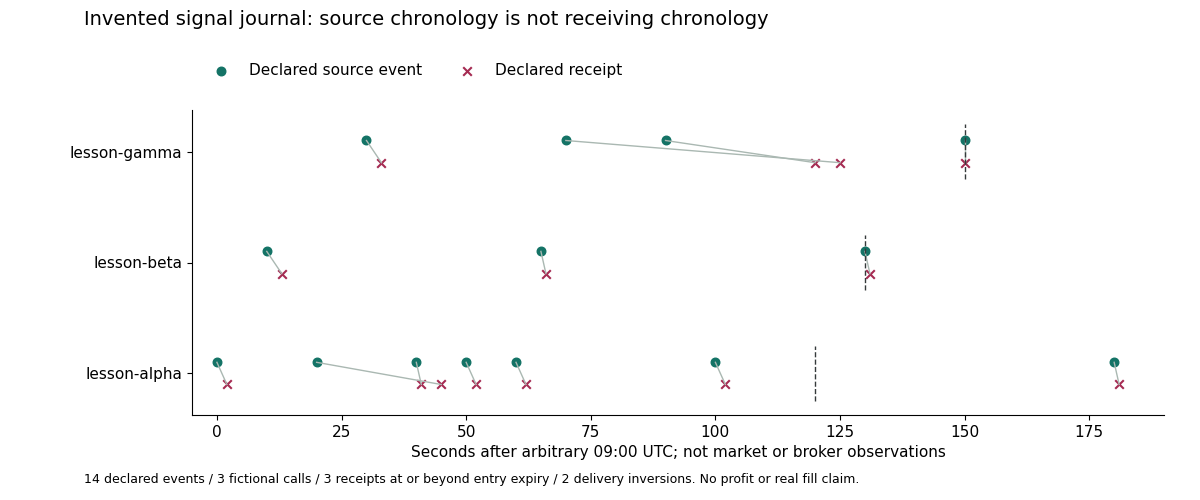
Alpha's cancel_remaining event follows its declared one-unit fill. A later withdrawal also follows that fill, and a separate close appears only afterwards. The case does not compute actual remaining account quantity because authentic order and execution sources are absent. A real partial-fill study must preserve executed quantities, remaining orders, cancellation acceptance, child resizing and actual position ownership under its chosen policy. Different copying or broker configurations cannot be mechanically assumed equivalent. If the source says only cancelled, ask which object was cancelled and which filled exposure remained rather than guessing either zero exposure or a completed losing trade.
No protective guarantee follows from the teaching case
The journal's expiry field concerns entry validity. It is not a guarantee that stop or target orders exist, a universal OCO rule, or permission to alter a minute exit policy. Actual intrabar ordering, gaps, financing and capacity need their own evidence. Keep native risk and maximum-hold ownership, whole-position exits and the canonical research fill convention intact unless separately authorised. A correct CSV import and a complete educational parent chain cannot replace that authority. The original source-to-order protocol remains the broader request sequence, while this lesson provides a narrower fictional cancellation finding without adding a trading engine, account connection or workstation-controlled production service.
Filled fictional interpretation case
The invented Alpha sequence is acknowledgement, fill, remaining-intention cancellation, withdrawal and later close. Those are five different declarations, not five filled trades or a certified bracket. The filled conclusion is that a cancellation label cannot erase the earlier declared fill, and neither that label nor a withdrawal supplies a closing execution. Actual remaining quantity, transmitted children, account permissions and protection are intentionally unverified rather than invented to complete the diagram.
| Object | Record | Bounded finding |
|---|---|---|
| Acknowledgement | a3 | Not a fill |
| Cancellation | a5 | Prior declaration remains |
| Close | a7 | Separate event, still invented |
Primary references and scope
Expanded source review: 13 October 2026. Documentation supports the stated mechanism, not a tested account, hypothetical fill or provider outcome.