CSV journals, quoted notes and spreadsheet-safe exports
Use a real parser, preserve literal notes and disclose spreadsheet formula escaping rather than splitting on commas.
CSV punctuation is part of the record
An event note can contain a comma, quotation marks or a newline without becoming another field or event. The Alpha amendment deliberately contains all three. Papa Parse 5.7.0 handles the CSV grammar, with dynamic typing disabled so exact identities and timestamps remain strings. The inspector then applies its own narrow column and event contract. It does not infer order instructions from note language or execute markup. A naive comma split would corrupt the example, while a naive line count would count a note newline as an extra event. The filled source packet therefore provides exact rows and independent reference counts, not only a screenshot.
Headers and types still need a contract
The parser's correct grammar is not a complete semantic validator. The tool requires exact ordered headers, one to five hundred rows, complete UTC seconds, bounded identities and supported event types. Duplicate event IDs and invalid version or parent chains are rejected. Optional quantity and price remain bounded positive declared decimals when present; fill and close rows require both. These are published format choices, not universal broker standards. Unknown headers are not silently ignored, malformed rows are not partially accepted, and input is not automatically normalised into a more favourable sequence. A correct shape still cannot authenticate the source or establish a complete real population.
A spreadsheet export has a different threat
Formula-leading text can be interpreted by spreadsheet software rather than displayed as an ordinary note. The CSV exporter uses the library's escapeFormulae defence, while JSON retains notes literally. The record discloses that spreadsheet escaping may prefix risky text, so that export is not marketed as exact byte identity for transformed notes. A formula-looking user note does not become code inside this page, whose table uses literal text nodes. Keep the received original file separately if exact bytes or a timestamp proof matter. Escaping a spreadsheet formula and verifying historical publication are distinct tasks with different evidence and no automatic financial conclusion.
Invalid input must retire the previous finding
When a journal is emptied, malformed or outside supported size limits, the inspector clears its result and disables export. It must not continue showing a prior valid population as though it described the new input. Pending local file or example reads are invalidated on later edits or reset. The original evidence notebook instead preserves existing notes after an invalid import; that is an intentional difference between a calculated result and an accumulated working record. Both remain browser-local with no input persistence, remote account connection, arbitrary URL fetch or production scheduler. Passing grammar, import and round-trip tests is software correctness, not an external provider audit.
Filled fictional interpretation case
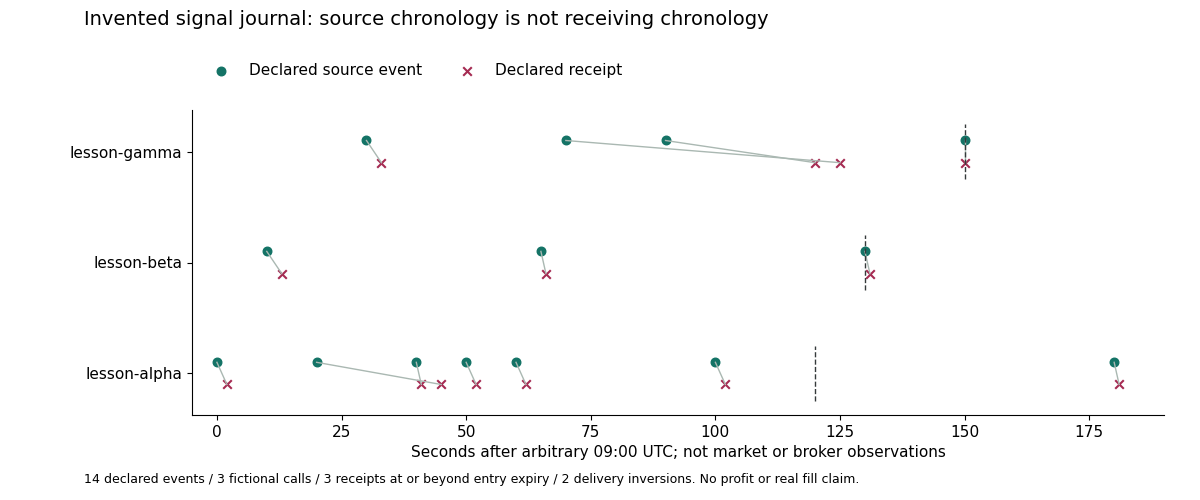
The Alpha amendment's quoted note occupies one logical CSV row despite its embedded newline. The full packet remains fourteen events and three signals after parsing and ordinary CSV/JSON round trips. A user note beginning with a spreadsheet formula symbol stays literal on screen and in JSON; the spreadsheet-safe CSV may add a defensive prefix. That transformation is disclosed and is not a source-authenticity or financial-validation claim.
| Object | Record | Bounded finding |
|---|---|---|
| Quoted comma/newline | a2 note | One logical event |
| JSON export | Exact note string | No code execution |
| CSV export | Formula escaping enabled | Byte identity not promised |
Primary references and scope
Expanded source review: 13 October 2026. Documentation supports the stated mechanism, not a tested account, hypothetical fill or provider outcome.