Event counts and financial outcome denominators
Keep original calls, updates, executions and completed-position classifications in separate populations.
An event journal has its own population
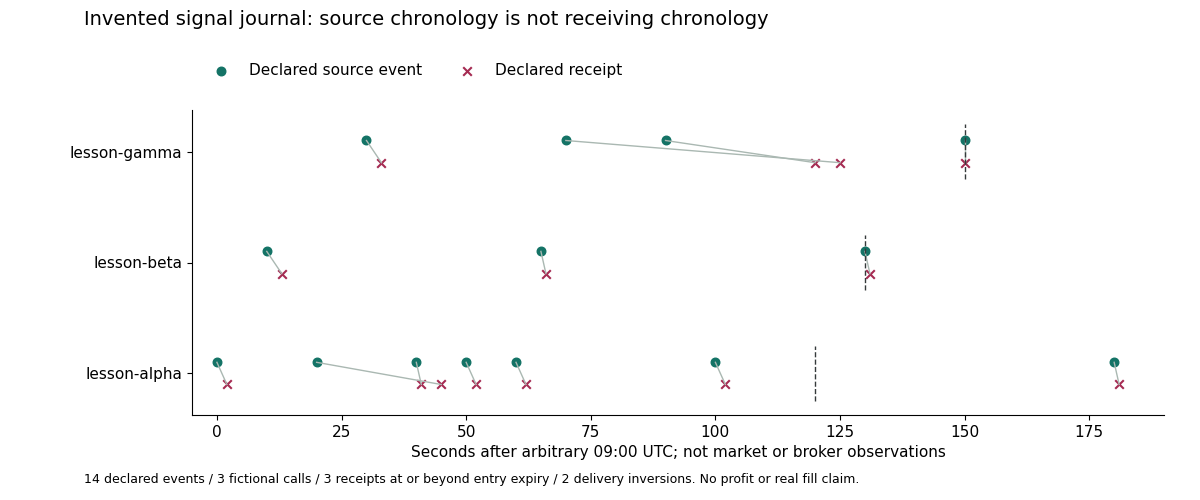
The reference population is fourteen source-ordered events under three fictional signal identities. Seven belong to Alpha, three to Beta and four to Gamma. An amendment, cancellation or expiry can generate another row without creating another trade. The parser reports event and original-signal counts while leaving financial win rate null. An actual financial denominator needs a different source and fixed classification rules. A tidy table cannot make every event independent, and a complete teaching object cannot supply complete provider coverage. Preserve original eligibility, continuous period and record acquisition when moving from this invented population to observed financial material.
Outcome labels require actual completed sources
Alpha has an invented close declaration, Beta has no fill declaration and Gamma has no close. They are not automatically one win and two losses. Price fields alone lack costs, currency, quantity economics and authentic execution. Withdrawal does not provide a net outcome, and entry expiry does not necessarily terminate a filled position. A genuine study must define completed winners, losers, flats, open exposure, unfilled calls and cancellations before counting them. Those statuses must be applied consistently across all eligible records. Keep missing cases visible instead of forcing a finished statistic from the subset whose last note looks most reassuring.
A separate invented denominator demonstrates the choice
Consider a different fictional outcome table with four winners, three losers, one flat, one open and one unfilled call. Including the flat among completed positions yields four of eight, or 50%. Excluding it gives four of seven, approximately 57.14%. Using all ten originals yields a 40% original-call winner share, a different statistic again. None is an observed provider result or future probability. The numbers are not extracted from the fourteen-event journal. Keeping this separate example labelled prevents a learner from accidentally combining two invented populations or presenting a favourable convention as the only valid denominator.
Financial completeness is not structural completeness
A correct format, valid parent chain or independently counted CSV population can coexist with no financial performance evidence at all. A cryptographic timestamp can identify included bytes under its independently checked bound while a complete eligible inventory remains absent. Personal competition accounts and supplied model summaries also have different subjects from receiving account outcomes. The publication invents no account return, actual reviewer cohort or calibrated confidence estimate to bridge those gaps. Request the appropriate full ledger, frozen policy, cost basis and independently scoped economic review. Software tests and educational cases are not extra financial observations or a substitute for the canonical independent master.
Filled fictional interpretation case
The new journal yields fourteen events, three original fictional calls, two declared fill events and one declared close event. It does not yield a winner percentage. A separate ten-call invented table can yield 50%, 57.14% or 40% depending on the named population, each answering a different question. These exercises remain separate, with no actual provider, subscriber account, period or performance audit attributed to their numbers.
| Object | Record | Bounded finding |
|---|---|---|
| Journal | 14 events / 3 signals | No financial winner share |
| Completed with flat | 4/8 = 50% | Separate invented table |
| Decisive only | 4/7 = 57.14% | Different named convention |
Primary references and scope
Expanded source review: 13 October 2026. Documentation supports the stated mechanism, not a tested account, hypothetical fill or provider outcome.