Grade calibration and frozen definitions
Ask for the producing grade definition and independent population before treating a letter as a probability.
The letter is a label until its contract is supplied
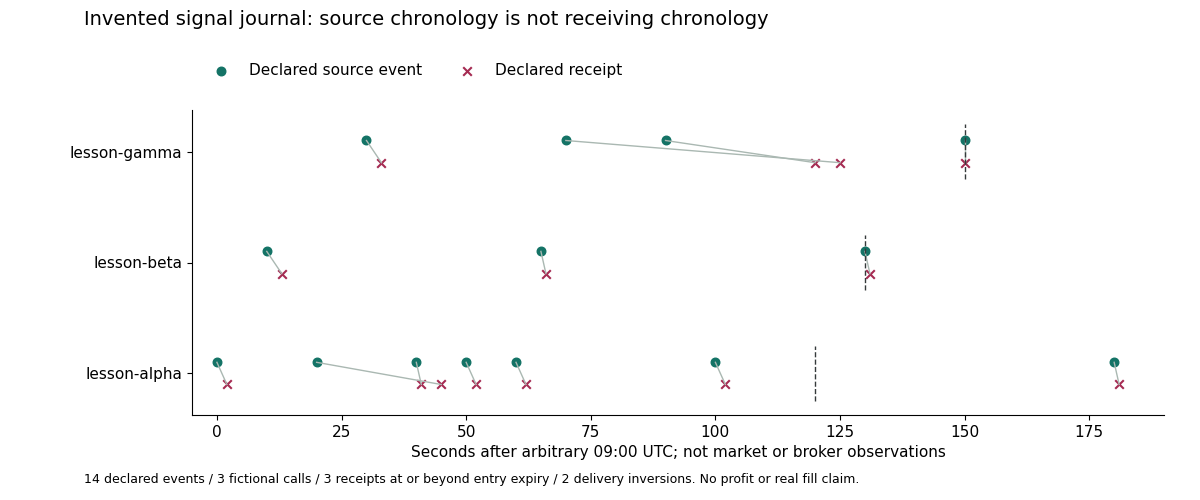
A producing model may attach a conviction grade, but its meaning belongs to that model's definition, horizon, objective and calibration population. A matching letter across products is not automatically comparable. The tutorial journal has no grades or independent calibration sample, so none can be inferred from its event count or declared prices. A real source request should retain the effective grade definition and dates, complete eligible observations and fixed outcome treatment. Do not quote a tidy grade legend as an observed probability or borrow a founder's separate personal account history to fill the missing per-model distribution.
Keep entry objective before exit-adjusted economics
The canonical research boundary trains and ranks entry candidates on their raw causal boundary-recovery objective, then freezes entry identity before the selected exit. Exit-adjusted return, win share, profit factor and holding-period drift can validate, reject, size and measure overlap under the authorised process, but should not silently define entry selection. This primer changes none of that method. It does not create a candidate tournament, reopen exit selection or route a new instrument through an unsupported model. A grade attached later to a message cannot retroactively change the objective that selected the entry, and a useful software fixture is not a financial validation sample.
A fictional comparison shows different subjects
Imagine two invented products both display grade A, but one grades a short boundary-recovery signal and another grades a longer-horizon research state. Their periods, labels, exit objectives and eligible populations differ. A matching historical winner share would not make their quantities, costs, timing or risks equivalent. An independent evaluation would need the correct frozen definitions and actual complete observations, not a selected set of favourable examples. This conceptual case does not assert an actual distribution at any named provider. The journal's Alpha and Gamma version questions are operational applicability issues; they do not supply either product's calibration records.
Retain the missing calibration rather than invent it
No calibrated probabilities, confidence bounds, actual order quantities or financial rankings are supplied by this publication. Attributed product grades remain separate from authenticated original bytes, complete outcomes and account suitability. An uncalibrated label is a specific evidence gap rather than proof that a real provider is fraudulent or every grade is useless. Keep the original conviction lesson and request its appropriate supporting records. The new practice and import tools help readers avoid a scope error, but they do not award professional certifier status, proprietary source rights, an independent research master or production authority merely because the explanation is internally consistent.
Filled fictional interpretation case
In a fictional two-product comparison, both letters read A while the entry objective, horizon and outcome populations differ. The completed conclusion is that a shared symbol does not establish comparable probability or allocation. The event journal supplies no grade observations at all. No actual model, account, calibration experiment or external reviewer measured these hypothetical products, and the lesson preserves the raw-entry versus fixed-exit research boundary rather than rewriting it.
| Object | Record | Bounded finding |
|---|---|---|
| Grade label | Same fictional letter | Definition required |
| Entry objective | Frozen raw subject | Not selected by later return |
| Calibration | No sample supplied | Probability unresolved |
Primary references and scope
Expanded source review: 13 October 2026. Documentation supports the stated mechanism, not a tested account, hypothetical fill or provider outcome.