Comparable and incomparable signal clocks
Separate declared event time, receiving time and independently established bounds before calculating a delay.
An ISO string is not an authenticated clock
The teaching record uses complete UTC seconds ending in Z, with actual calendar validity checked. That avoids ambiguous local-time strings inside this particular CSV contract. It does not prove that a real source clock was accurate, independent or contemporaneous. A provider-controlled signal_time, a device receipt, an API response and a completed timestamp attestation can have different origins and guarantees. Record those origins before subtraction. A complete string with a timezone label can still describe a copied or backdated claim. Correct parsing is therefore a prerequisite for selected arithmetic, not an independent publication audit or a guarantee of honest chronology.
State which differences can be computed
Each reference row declares event time, receipt time and entry expiry on comparable clocks. A receipt cannot precede its event under that selected contract. The parser rejects such input instead of inventing a clock correction. Actual systems can have drift, differing capture points or unavailable source times, so rejection here should mean the input does not meet this contract, not that a real operator is fraudulent. A stronger study needs independently sourced timing and the uncertainty or precision attached to each record. Do not treat an acknowledgement timestamp as device delivery, or a submitted digest as a completed Bitcoin time bound.
Two chronologies can be internally consistent
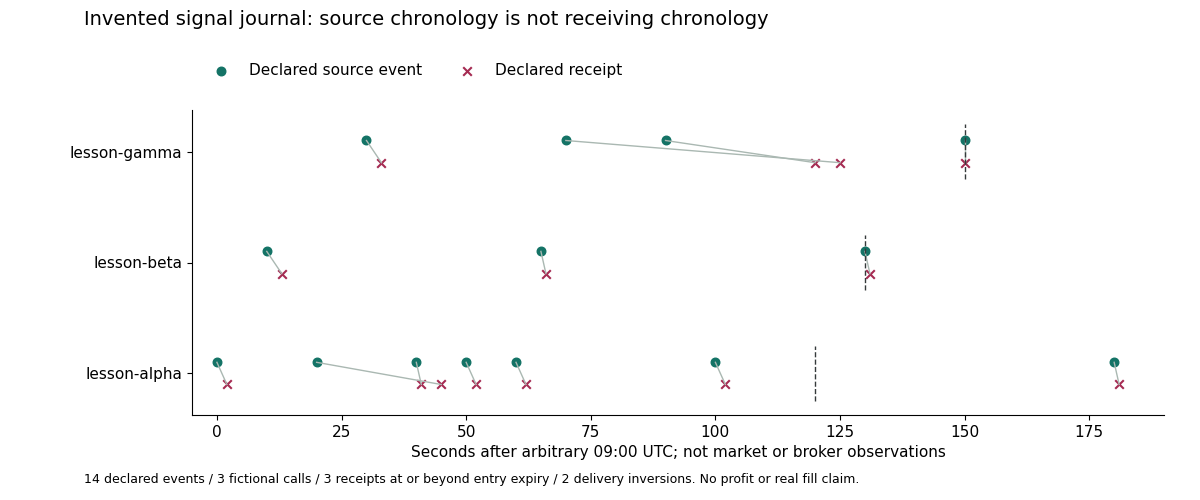
Alpha's amendment is declared at 09:00:20 and received at 09:00:45. The acknowledgement is declared later, at 09:00:40, but received earlier, at 09:00:41. The source order and receipt order differ. That is a delivery inversion, not a negative delay within either row. The tool preserves both. Quietly sorting all rows by receipt time would change the declared source sequence; quietly assigning the amendment's source time to the consumer would invent availability. Effective application remains open until actual receiving and processing records identify what the consumer or order owner knew at each decision.
Expiry does not provide the missing provenance
A received event at or beyond declared entry expiry receives a timing flag. It does not automatically make every later action invalid, force a position exit, or establish a completed loss. Alpha's later close after entry expiry is a different event; Gamma's exact-boundary withdrawal supplies no closing fill. The latency worksheet remains a separate assumed-window calculation. Neither task authenticates a real event or measures platform speed. Keep original clocks, precision, scope and effective policy with a future observed study, and do not combine arbitrary tutorial timestamps with authentic broker records to manufacture a complete-looking chronology.
Filled fictional interpretation case
Under the declared reference clocks, Alpha's amendment delay is 25 seconds and acknowledgement delay is one second. Neither is negative, but the receiving sequence has an inversion. Gamma contributes another inversion. Three other receipts are at or beyond entry expiry. The completed finding is two chronological differences plus three boundary flags on invented rows; it is not a measured delivery distribution or a conclusion about any actual signal channel.
| Object | Record | Bounded finding |
|---|---|---|
| Event-to-receipt | 25 seconds for a2 | Declared comparable clocks |
| Receiving order | a3 before a2 | Applicability unresolved |
| Exact expiry | c4 | Late boundary, not automatic exit |
Primary references and scope
Expanded source review: 13 October 2026. Documentation supports the stated mechanism, not a tested account, hypothetical fill or provider outcome.