Signal identities and parent chains
Distinguish one original call from updates and keep exact parent relations without claiming cryptographic authenticity.
One identity, several source objects
A signal identity groups an original instruction and its later events. An event identity names a specific publication, amendment or operational declaration. The distinction matters because a channel can contain many messages for one idea while a financial ledger counts completed positions under another rule. The teaching journal uses separate event_id and signal_id fields, one original publication and preceding same-signal parents. That contract is published rather than inferred from arbitrary message text. A real platform may use a different reply or order-link structure; it needs its own source definition before any imported row is interpreted as part of an authentic chain.
A version number does not erase the original
The fictional Alpha original is version one. Its amendment increments to version two and preserves the first record. Later acknowledgement, fill, cancellation, withdrawal and close retain version two because they do not claim to amend the instruction. An update that changes the expiry must be declared as an amendment under this tutorial contract. An original silently replaced by an improved version would destroy the earlier evidence. Keep exact original bytes and later changes in an actual review, even if only the latest instructions matter to a receiver. Historical interpretation and current effective state are different tasks with separate records.
Parent validation is structural, not signed proof
A valid parent points to the preceding same-signal event in the reference. Duplicate event identities, duplicate original publications, missing parents and jumps to another signal are rejected. That checks an internal relationship, not the source's authority or existence before an outcome. A CSV fabricated after a trade could pass this format. Authentic chronology requires independently scoped evidence, and financial completeness requires the actual eligible population. The inspector does not verify digital signatures, calendar receipts or blockchain attestations. Its JSON leaves actual broker fills and financial win rate null even when all fourteen invented events satisfy the structural contract.
Keep order identities outside the shortcut
An actual broker order can have client, broker, replacement and execution identifiers that do not equal a message reply ID. Acknowledging one order does not acknowledge every amendment in a signal thread. Partial fills and remaining quantity also belong to actual account state. The tutorial deliberately does not reconstruct these identities or submit orders. If a real record omits them, retain the omission instead of filling plausible IDs or relabelling a publication as an execution. The original source-to-order guide supplies the wider request sequence, while the new chain lesson provides a narrower completed structural reference that readers can independently count.
Filled fictional interpretation case
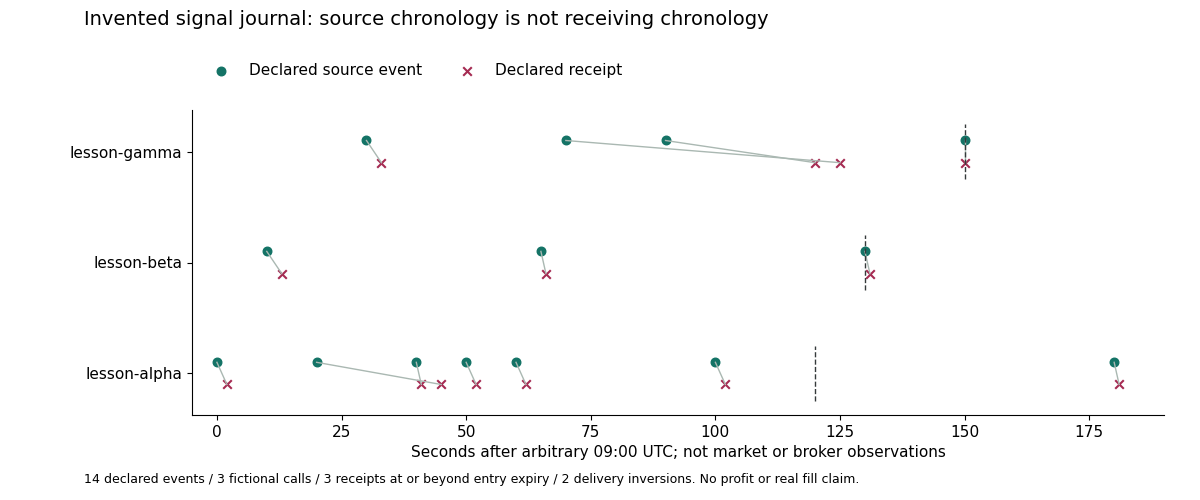
Alpha has seven events under one signal identity, Beta three and Gamma four. Together those fourteen rows are only three original fictional calls. Alpha's cancel_remaining parent follows its declared fill, while its close comes later. The correct finding is a linked source chain with separate event roles, not seven trades or an authenticated broker sequence. Every price, label and clock in this example is invented and cannot be assigned to any provider.
| Object | Record | Bounded finding |
|---|---|---|
| Original Alpha | a1 / v1 | Keep first instruction |
| Amendment | a2 / parent a1 / v2 | Preserve original |
| Later close | a7 / parent a6 / v2 | Separate execution declaration |
Primary references and scope
Expanded source review: 13 October 2026. Documentation supports the stated mechanism, not a tested account, hypothetical fill or provider outcome.