Trigger, limit and reference prices in a signal
Name what a level controls before turning a message into an assumed fill.
A number does not define an order
A level in a message can be an informational reference, a trigger, a price limit or a hypothetical research entry under another convention. Its meaning belongs to the source instruction and effective policy. A reader cannot safely reconstruct that policy from the word buy beside a price. Preserve original context and ask which event activates the instruction, how long it remains eligible and who owns quantity and exits. The public order-type reference explains distinct mechanisms; it does not establish that any particular provider or receiver selected one. The educational journal contains declared events, not free-language parsing that submits trades.
Triggering and executing answer different questions
The SEC distinguishes market, limit and stop-related order mechanisms. A limit is not a guaranteed execution, and a stop's trigger is not a guarantee of that same execution price. The exact selected broker implementation and restrictions still need current official documentation. The tutorial does not calculate actual liquidity or order routing. A price reaching a displayed chart level can be relevant to a condition while actual bid/ask, eligibility, quantity and receiving order state remain unresolved. Keep the configured trigger and actual fills as separate records rather than applying the most favourable interpretation after the outcome is visible.
A reference fill policy is not a broker journal
A research source may use an established hypothetical observation-window entry convention. That convention must be retained with its actual frozen rules rather than silently replaced by first available price or a later favourable quote. The new journal does not implement or change that canonical convention. Its positive price fields are invented declarations for literacy, not real history, calibrated model outputs or executable fills. No actual ticker, exchange, contract or broker account is attached. A real performance study needs the policy, data and complete eligible population before any entry-to-exit result can be independently calculated or compared with a receiving account.
Amendments do not retroactively resolve ambiguity
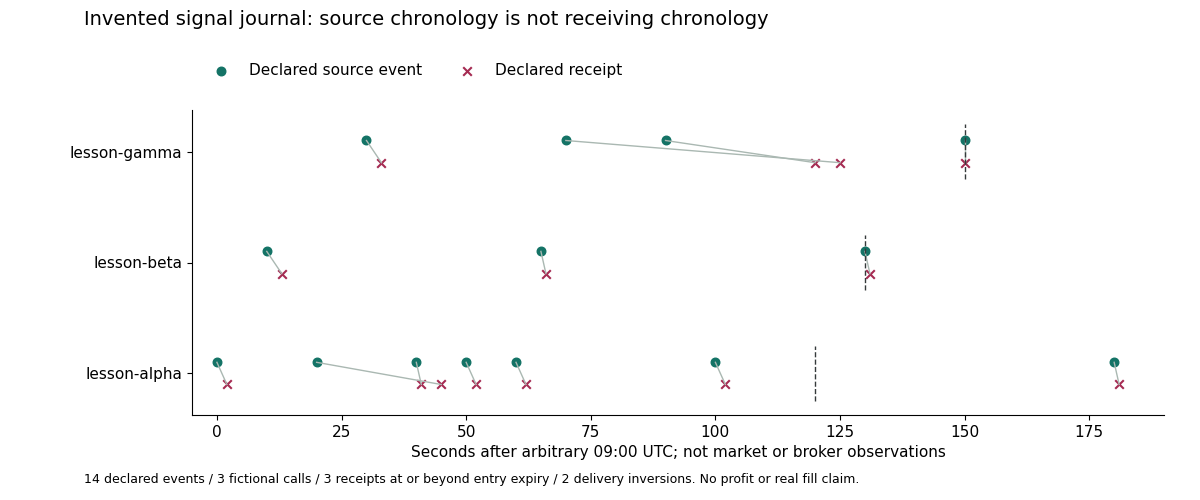
Alpha's amendment note says wait rather than market buy, but it is received after a later acknowledgement. A stronger conclusion about effective instruction requires actual application records. A later clarified sentence cannot be silently treated as the instruction available earlier. Keep original and amended fields, producing time, receiving time, reason and authoritative state. Beta's lack of a fill and Gamma's absent close must remain missing rather than being inferred from a familiar price label. The original level-reading protocol and source-to-order guide remain useful alongside this narrower distinction; neither grants execution permission or a profitable-system certificate.
Filled fictional interpretation case
An invented message shows 100 as a reference and later reports a fill at 100.1. The difference does not establish slippage until the original order/fill convention and executable data are known. A limit at 100, a trigger at 100 and a research reference at 100 are three different contracts. No actual service or broker used these numbers in this lesson; the completed finding is an unresolved level meaning rather than a fabricated execution.
| Object | Record | Bounded finding |
|---|---|---|
| Reference | Informational level | Not necessarily an order |
| Trigger | Activation condition | Not a fixed fill |
| Limit | Price condition | Execution unresolved |
Primary references and scope
Expanded source review: 13 October 2026. Documentation supports the stated mechanism, not a tested account, hypothetical fill or provider outcome.