Bid, ask, chart and execution references
Name the quote basis and actual order source before interpreting a touched level as a filled trade.
A chart observation has a price basis
A chart can display a last trade, bid, ask, midpoint or another defined series. The observed level must retain that basis, its timestamp and source before it is compared with a signal. The SEC glossary distinguishes bid and ask as different sides of a quote. Neither a familiar chart colour nor a rounded last price can establish the executable level for every order. The teaching journal has no real bid/ask feed and makes no such fill claim. Its declared prices remain invented strings. A genuine review needs the actual market data and order convention, not a later screenshot labelled reached target without the supporting source.
An invented spread shows why the basis matters
Suppose a fictional quote has bid 99.9, ask 100.1 and midpoint 100.0. Seeing the midpoint at 100.0 does not on its own establish a purchase execution at 100.0. Nor does seeing an ask above a target establish that a particular sale filled. Order type, size, liquidity, permission and actual execution records remain separate. These values are invented to explain the distinction, not observed prices or a broker recommendation. The lesson does not install an execution simulator or award the best quote as a hypothetical research fill. The established canonical observation-window policy remains unchanged and separate from actual broker trades.
Trigger definitions must remain effective-version specific
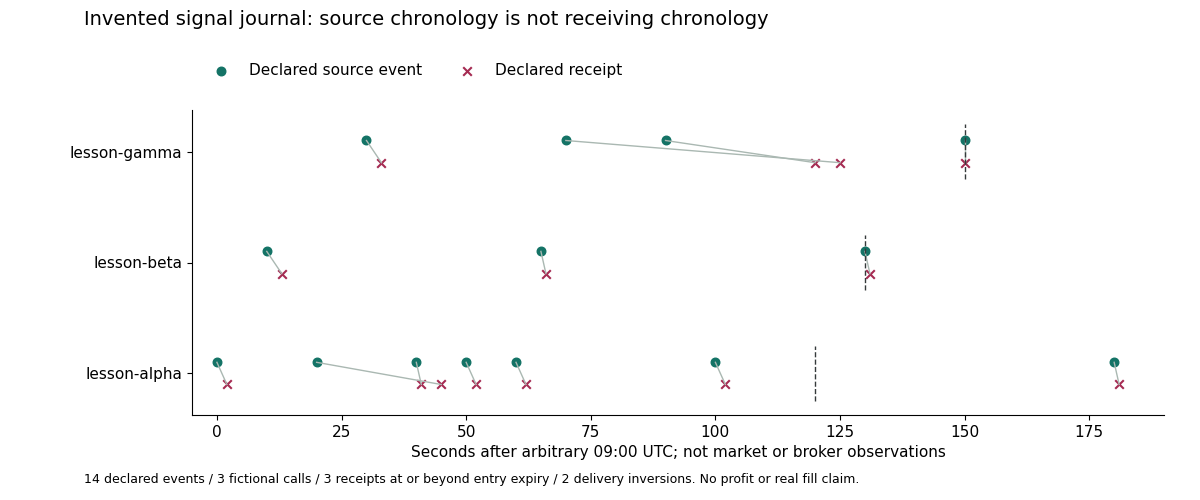
The condition that activates an instruction can depend on the producing system and selected configuration. A trigger tied to one data basis cannot silently become a different basis when that improves a later outcome. Keep the original definition, effective revision, source availability and actual consumer records. Alpha's amendment delivery inversion illustrates the missing applicability question, while the original chart-alert documentation supports a mechanism rather than authenticating this fictional chain. A real study must distinguish which event was declared from which condition or order actually became active. Rewriting a favourable later interpretation into the original alert would destroy useful historical evidence.
Account economics remain another source request
Even an actual fill price does not provide net account return without quantity economics, costs, cash flows, currency and complete positions. The reference declares only invented events and leaves verified broker fills and financial win rate null. Its CSV parser cannot identify the real venue, certify market depth or measure slippage from absent data. A price difference might be relevant after those sources exist, but it cannot be promoted into a measured provider outcome by arithmetic alone. Preserve the quote basis, complete eligible record and fixed calculation when extending this lesson to observed material, and retain any unresolved comparison rather than inventing execution assurance.
Filled fictional interpretation case
At the fictional 99.9/100.1 quote, the midpoint is 100.0. A chart touch of 100.0 is therefore a different observation from an actual order execution. The completed finding is a quote-basis distinction plus missing order and liquidity evidence. The example supplies no actual account, contract, ticker, market session, provider or price series. It cannot validate a published entry, reproduce a proprietary model or predict the receiver's eventual net result.
| Object | Record | Bounded finding |
|---|---|---|
| Bid | 99.9 invented | Quote side, not guaranteed fill |
| Ask | 100.1 invented | Different quote side |
| Midpoint | 100.0 arithmetic | Not actual execution |
Primary references and scope
Expanded source review: 13 October 2026. Documentation supports the stated mechanism, not a tested account, hypothetical fill or provider outcome.