Entry expiry is not a position exit
Keep call validity, remaining-order cancellation, withdrawal and executed closure as different events.
An eligibility window has a specific subject
A stated expiry may bound how long a new instruction is eligible, but its meaning belongs to the actual producing and receiving policies. It is not automatically a deadline for every filled position to close. Name whether the boundary concerns publication, receipt, order submission, activation, acknowledgement or execution. The reference contract flags receipt at or beyond declared entry expiry, using greater than or equal. It does not simulate a broker's validity checks or change an authorised research convention. A message can be expired for a new entry while an existing position remains subject to its separate effective exit and risk rules.
Cancellation preserves the filled part
The fictional Alpha fill declaration precedes a cancel_remaining event. The latter addresses remaining intention in the teaching record; it does not negate the earlier filled unit. A subsequent withdraw message likewise does not supply a closing execution. Actual broker cancellation needs its own request, acceptance, remaining quantity and authoritative order state. A text message saying cancelled may be ambiguous about which object changed. Keep that ambiguity rather than treating a convenient word as proof of zero exposure. The new journal provides complete example rows for these distinctions while actual account, currency, contract multiplier and broker records remain absent.
Exact boundaries need declared comparisons
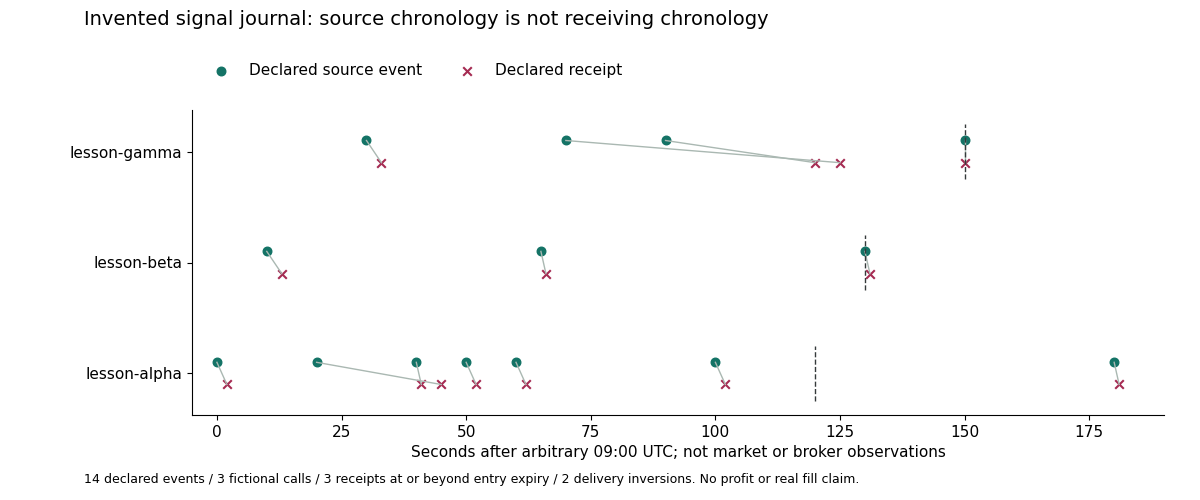
Gamma's withdrawal receipt equals its entry expiry at 09:02:30. The inspector marks it late under the stated greater-than-or-equal rule. That is a completed timing finding, not a sale instruction, invalid-fill judgment or net outcome. Beta expires without a fill declaration, so it remains unfilled in the supplied exercise rather than a completed loser. Alpha has a separate later close declaration. The cases show three different missing or supplied objects despite sharing an expiry field. An actual system might apply different boundary semantics; those must be sourced and frozen rather than borrowed from an educational CSV contract.
No exit authority is created by a lesson
This publication does not install a stop manager, bracket controller, daily profit floor or account closing service. Canonical minute execution, whole-position native exits, maximum-hold rules and the established hypothetical research fill convention remain unchanged. A real operator needs actual policy identity and persisted ownership before changing exit behaviour. The journal is an interpretation exercise, not an implementation of those systems. Preserve original evidence and state which closing source is missing; a finished form or correct expiry calculation cannot authorise a production promotion, replace an independent research master or certify a subscriber receiving route.
Filled fictional interpretation case
Alpha declares a one-unit fill at 09:00:50, remaining-intention cancellation at 09:01:00, withdrawal at 09:01:40 and separate close at 09:03:00. Its entry expiry is 09:02:00. The filled educational conclusion is that those four events are not interchangeable. No actual account profit, safe allocation or broker state is inferred, and the after-expiry close is not automatically called invalid merely because entry eligibility ended earlier.
| Object | Record | Bounded finding |
|---|---|---|
| cancel_remaining | a5 | No closing fill |
| withdraw | a6 / c4 | No automatic closure |
| close | a7 | Separate declared exit |
Primary references and scope
Expanded source review: 13 October 2026. Documentation supports the stated mechanism, not a tested account, hypothetical fill or provider outcome.